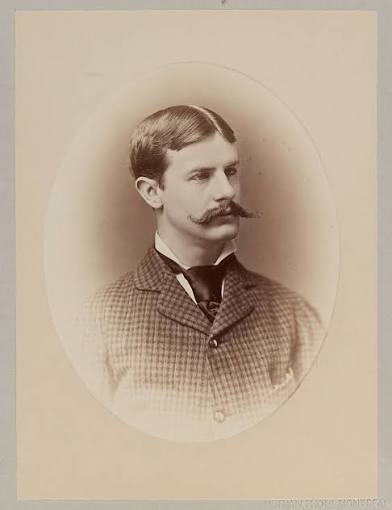
 Edmund March Wheelwright (September 14, 1854 – August 15, 1912) was a prominent New England architect best known for his municipal work in Boston, Massachusetts.
Queer Places:
Harvard University (Ivy League), 2 Kirkland St, Cambridge, MA 02138
Massachusetts Institute of Technology, 77 Massachusetts Ave, Cambridge, MA 02139
Oak Hill Cemetery, 4 Brown St, Newburyport, MA 01950, United States
Edmund March Wheelwright (September 14, 1854 – August 15, 1912) was a prominent New England architect best known for his municipal work in Boston, Massachusetts.
Born in Roxbury, Massachusetts, to parents Hannah and George W. Wheelwright. His father was a paper manufacturer and printer, providing a liberal atmosphere that nurtured Edmund's early intellectual and artistic pursuits.
He attended the Roxbury Latin School, graduated from Harvard University in 1876, and specialized in architecture at the Massachusetts Institute of Technology (M.I.T.) between 1876 and 1877.
He trained under several prominent architectural firms, including Peabody & Stearns in Boston, McKim, Mead & Bigelow in New York, and E.P. Treadwell in Albany, before undertaking an influential study trip across Europe in 1881 and 1882.
Wheelwright opened his own architectural practice in Boston in 1883. He later formed partnerships, working through firms such as Wheelwright & Haven and Wheelwright, Haven and Hoyt.
From 1891 to 1895, Wheelwright served as the official City Architect of Boston, a tenure defined by significant municipal building projects, including fire stations, bridges, and infrastructure. Some of his designs includes: The Harvard Lampoon Building (often described by contemporaries like Barrett Wendell with "freakish gayety and beauty"). Wheelwright was one of the founders of the Harvard Lampoon during his college years and drew its first cover. The Longfellow Bridge. Portions of the Museum of Fine Arts, Boston (on Huntington Avenue). The Massachusetts Historical Society building on Boylston Street.
He was elected a fellow of the American Institute of Architects (AIA) and served on its board of directors, alongside acting as secretary for the Boston Society of Architects. He also authored standard reference texts on educational architecture, including The American Schoolhouse.
John Brooks Wheelwright carried on a rebel tradition inherited from his father, Edmund, characterized as rambunctiously and aggressively antiphilistine. This spirited nonconformity manifested in projects like the Harvard Lampoon, as well as his witty Rollo parodies.
Biographical accounts note that the high-strung architect remained a bachelor until age thirty-three, when he married Elizabeth Boott Brooks. Though the marriage produced children, it coincided with a period of severe personal strain. The pressures of his life and work contributed to a "long term stress," deep melancholia, and extreme depression that culminated in a nervous breakdown in 1910 and his tragic suicide in 1912. Among his final architectural achievements was the Harvard Lampoon building itself.
Wheelwright and Elizabeth Boott Brooks had three children who survived to adulthood: Louise, Edmund Jr., and the poet John Brooks Wheelwright.
Wheelwright experienced prolonged professional stress culminating in a severe "nervous breakdown" and deep melancholia around 1910. He spent his final two years in a sanitarium in Thompsonville, Connecticut, where he passed away on August 15, 1912.
References:
Support this project
This website is a passion project researched, developed, and funded entirely by me. If you find the content valuable and would like to help support the ongoing research and hosting costs, any contribution is deeply appreciated.
Thank you for keeping this independent resource alive!
My books on Amazon: Elisa Rolle's books